
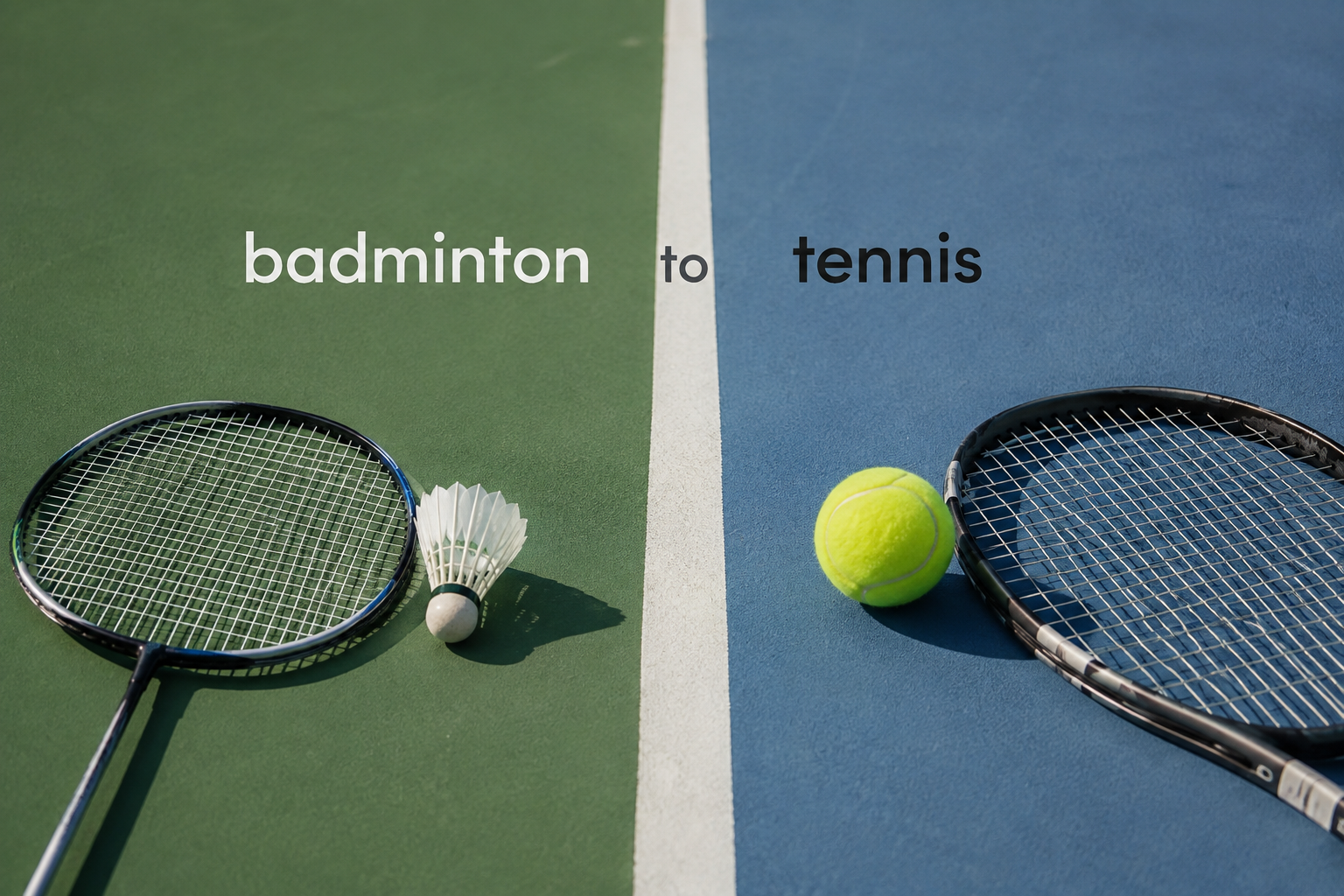

I recently picked up a tennis racket and found myself adapting to it faster than I expected. You can watch it on Instagram by clicking here.
Now, before the clips convince anyone otherwise (haha), I should clarify that adapting quickly and playing well are two very different things. I was not suddenly a tennis player. I simply did not feel completely lost.
As someone who has spent considerably more time playing badminton, I expected tennis to feel unfamiliar from the beginning. Instead, certain things seemed to carry over almost immediately. Judging where the ball was going, moving into position, anticipating its arrival and trying to time contact all felt like variations of problems my body had solved before.
Also Read: Why You Keep Getting Foot Blisters While Playing Badminton (And How to Fix It Permanently)
Skill transfer:
That probably isn’t entirely surprising. Sports science has long been interested in what is known as skill transfer: the idea that experience in one activity can sometimes make learning another easier. The transfer is strongest when the two activities share similar perceptual or movement demands, although experience never transfers perfectly.
And perhaps that was exactly what I was experiencing. I did not know how to play tennis, but I was not starting from zero either.
Badminton had given me a certain familiarity with rackets, footwork and the basic challenge of reading something travelling towards me at speed. Cricket probably added another layer. Years of watching a ball, judging its trajectory and trying to time an interceptive movement may not teach someone how to hit a tennis forehand, but perhaps they make the underlying problem feel less alien.
Still, this is where the similarities ended.
Fact: The fastest recorded badminton smash reached 565 km/h (351 mph) while the fastest recorded Tennis serve reached 263 km/h (163.4 mph).
The Volley:
The volley, for instance, felt nothing like badminton to me. In badminton, I am used to an extremely light racket and a shuttlecock that behaves very differently after impact. With a tennis ball, there was a solidity to the contact that I wasn’t prepared for. More than once, I felt a distinct jolt travel through my hand.
Fact: While a tennis ball can weigh around 57 grams, a badminton shuttlecock weighs just 4.7 to 5.5 grams, making the two sports remarkably different despite relying on many of the same fundamental coordination and movement skills.
Also Read: Vegetarian Badminton Diet: What I Learned After Years of Playing Without Protein
And then there was the biggest surprise of all:
The Exhaustion:
A few minutes of tennis left me considerably more tired than I had expected. This seemed particularly strange because badminton, at least to me, has always felt like the more explosive sport. Rallies can be frantic, movement is sharp and sudden, and the physiological research on competitive badminton supports the idea that it can place extremely high demands on the cardiovascular system. In fact, a review comparing several racket sports found badminton to have the highest heart-rate and metabolic intensity measures among those examined.
So why did tennis feel more exhausting to me?
My first instinct was to blame the racket. A tennis racket is significantly heavier than the one I am used to in badminton, and repeatedly accelerating and controlling that extra weight certainly felt different. But unfamiliarity probably played an equally important role. When your technique is inefficient, every movement costs more than it should. Muscles that are perfectly comfortable in one sport may suddenly be asked to stabilise, accelerate and absorb force in ways they are not accustomed to.
In other words, perhaps tennis wasn’t necessarily more demanding. Perhaps I was simply much worse at being efficient at it.
Bottom Line:
And that, I think, was the most interesting part of the experience. Being reasonably comfortable with one racket sport did not give me proficiency in another. It simply gave me a head start. I could recognise some of the problems, anticipate certain movements and adapt more quickly, but I still had to learn the language of an entirely different game.
Maybe that is the real advantage of playing multiple sports. You do not carry every skill with you. You carry a library of experiences.
And sometimes, when you pick up a new racket, that library tells you just enough to avoid feeling completely lost 🙂
A fact before we end: Olympic Debuts, Almost a Century Apart
- Tennis: First appeared at the modern Olympics in 1896.
- Badminton: Made its Olympic debut much later, at the 1992 Barcelona Olympics.
A particularly interesting detail is that tennis was removed from the Olympic programme after 1924 before returning as a full medal sport at the 1988 Seoul Olympics.
Stay updated with breath badminton, follow us on Instagram and YouTube.
Read Next: The Greatest Never to Win: Legends Who Missed the Ultimate Prize


Discussion
0 CommentsShare your thoughts — every perspective adds value.